Friday, June 21, 2013

Things Just Happen Along the Way

Life is not a problem to be solved, but a mystery to be lived.
~Charlotte Joko Beck

Things Just Happen
Along the Way

“Everything happens for a reason.”

Sorry, I don’t buy that. But I think I understand why we say it and why we want it to be true: because the alternative is even more scary—that sometimes things just happen, and there’s no reason for it.
Christians and non-Christians alike buy into this cultural folk theology. I have been at the scene of a tragic, or unexpected death, being with the family as they are in shock and grieving, and it makes no difference whether they are religious, whether they are “spiritual” or not—they say the same thing to each other for comfort: Everything happens for a reason.
I find it interesting that the concept is comforting, even though we never know the reason. God is under no more compulsion to explain Himself to us than He was to Job. So, knowing that there is a reason, but never knowing the reason…is comforting?
Apparently it brings back a sense of order into the midst of chaos, shock, trauma. Those are the times when everything feels out of order, times when one’s world is collapsing in on itself. We don’t have a clue what the reason is, but we are sure that there must be one. Otherwise the world—my world!—is truly out of control, if things like this can “just happen.”
I’ve heard families guess at the reasons.
“It was just their time.” Again, order. Their appointed, scheduled time had come. “When it’s your time, it’s your time, and there’s nothing you can do about it.” The authority and the structure of order. The one that really bothers me, however, is: “I guess God needed him in heaven more than we needed him here.” For what, for cryin’ out loud?! Heaven is heaven—it is paradise, and there is no evil there. God is in full reign there. What on earth would God need that person for in Heaven? God needs help running the place, and this was just the guy?
I think meaning comes into play more than anything. A reason gives meaning, and if we are going to suffer great loss, such shock and trauma, there damn well better be meaning behind it! It better stand for something. It better have a purpose other than making me miserable. Even if it is a reason I will never know in this life, the fact that there is a reason means there is meaning in what I am going through. I think that it why we choose to believe that everything happens for a reason. Reason assures us that there is meaning—even if we never know the meaning, either.
“I know there must be a reason. If I just knew what it was I could accept it.”  I’m not sure that is an answer, either. We humans seem to have a talent for arguing with God for our own wants. I think that if God did tell us the reason, we’d likely not accept it. Or, since God’s ways are so far beyond our ways, if God did explain it to us, it would be so far above our heads that we would not have a clue what in the world He is talking about. It would give no comfort whatsoever. “What does that mean?” I haven’t a clue. It is beyond me.
We live in a Fallen World where some things tragically just happen. That is part of the falleness of this world. Part of the tragedy of the fallen state—some things just happen. Tornadoes are not guided, they just touch down and wreck havoc. Illness and disease is a part of living in a Fallen World. So are accidents, and what do we say about accidents? They just happen, right? But I do have to admit, sometimes it does seem as though things are purposely piling up on me. I talked with a woman who, having just won her third bout with cancer, is now probably going to have a leg amputated. She wondered what it was she had done that was so bad that God was punishing her. When I told her that I didn’t thing that God was punishing her, but that we live in a Fallen World where this happens, she pursed her lips and gave me a very disagreeing stare. Is it possible that even believing in a reason like being punished by God is more preferable than “just happens?”
Don’t get me wrong—I’m not saying that nothing happens for a reason. I’m not saying that God does not at times allow things for His own reasons, or that God does not sometimes cause things. I believe in those, too. I’ve read too much of it in the Bible not to believe it. But I also believe that we live in a Universe that contains uncertainty, unpredictability, and chaos. I think some things—not all things—but some things just happen.
When things just happen for no reason, I think the meaning is found in what God does with it in our lives. I talked about this last time. It the process of God’s healing of our heart and emotions that gives meaning to what otherwise would be meaningless. This is why, every time I’m around the bed of a deceased patient, gathered with the family, and I pray the prayer of committal, I always pray for God to be very close to the family; for the family to cling to one another, and to cling to God. For it is God’s process work of healing that brings meaning.  
                Leviticus 14 tells us that if a house has mold in it, the owners of the house must clean the house thoroughly, and then send for—of all things—the priest. The priest? Why would one send for the priest? Because it is only the priest that could declare the house as being “clean.” The point is this: no matter now “holy,” righteous, moral, upright or religious a family is, even their house gets mold and becomes “religiously unclean.” Why? Because even the holiest of persons experience the “fallout” of living in a Fallen World.
                Disease. Accidents. Heart attacks. Fires. Tornadoes. Floods. These things can and often do just happen, and they are part of the fallout of living in a Fallen World. Recently I was with a family who’s loved one suddenly coded and died. It took them ninety minutes to make it to the hospital from the small town they lived in. I heard the doctor tell the family that she had no idea why it happened. The patient’s heart surgery had gone textbook perfect, all of the tests and scans showed that his heart was working beautifully, that there was no reason to expect anything but a complete and total recovery. “Sometimes these things just happen,” she told them, “and there’s no apparent reason for it. I’m sorry.” I talked with the wife afterwards. She was in her 80’s, and had been one of the Lord’s servants since her teenage years. So had her husband. “My husband woke up in heaven this morning,” she told me with a smile and tears in her eyes, “and I don’t think he cares at all what the reason was. I’m going to miss him terribly, but I know the Lord is in here,” she pointed to her heart. “and He will help me through this.”
                We’ve all heard of black holes, the great, destructive vacuum cleaners of space. When a black hole appears, it sucks in anything and everything that gets caught in its gravitational pull, and rips it apart to the molecular level. That, my friends, is destruction. What we don’t hear about are the white holes at the other end. This is the exhaust vent of these monstrous vacuum cleaners. Whatever is sucked in by at the end of the black hole, its energy is then spewed out of the other end—the white hole—and that energy is reclaimed and processed back into the life of the Universe. Nothing is wasted, since everything in the Universe is basically made up of energy. Even the table that this laptop is sitting on is really vibrating, living energy, even though it seems dead and inert.
                I think that even that which “just happens,” that which had no meaning, is still made up of energy, and that energy has an effect on us. It can pull us in and destroy us emotionally and spiritually, like a black hole, and we can choose to never get over the tragedy, the loss. I heard of a woman who lived through the Holocaust, and never recovered from it, no matter how much her daughter told her that she needed to. She took the chaos, the negative energy, and absorbed it, and it destroyed her spirit little by little. She carried it in her heart and soul and let it destroy her.
                God “brings us through to the other side” of tragedy, of meaningless suffering, of that which tears our worlds and hearts apart. The presence of God Himself IS meaning. God makes all things new. He takes the destructive energy of that which is happens to us, and through His Holy Spirit, transforms it. Darkness. Death. Destruction. Chaos. That energy is transformed by His Presence in us, and He gives meaning through the transformative process of healing and renewal.
                Renewal. A powerful word. But He’s a powerful God.
                About two decades ago, one of my seminary professors said something that has always stayed with me…

Nothing can separate us from the love of God.
Not even meaningless suffering.

Your Fellow Traveler,
~Steve

**Note: I’m leaving on vacation Thursday, and will be gone through the first week of July. I’m going to Indiana to see our daughter, who is expecting our first grandchild. On July 2nd, my wife’s birthday, we will find out the gender. And I will be performing the wedding of my daughter’s best childhood friend. It’s going to be a great time. So I won’t be posting again around July 12th.
                As of today, this blog has had 1,355 page views. Wow. Apparently I don’t know who a lot of you readers are. But thanks for reading! I greatly appreciate it.
~Steve

Saturday, June 15, 2013

Order from Chaos--A Cycle of Life

Life is not a problem to be solved, but a mystery to be lived.
~Charlotte Joko Beck

Order from Chaos
A Cycle of Life

When God began to create heaven and earth—the earth being unformed and void, with darkness over the surface of the deep, and a wind from God sweeping over the water—God said, “Let there be light…  Genesis 1:1-3a, The Jewish Study Bible

I don’t think we really read what Genesis 1:1 says—and doesn’t say. It does not say that in the beginning of earth’s creation there was nothing, and God created the world out of nothing. It does not say that. Now, simply pointing that out makes my Christian friends turn red with anger and start blowing out veins in their foreheads, and they accuse me of denying the power of God the Creator. I am saying nothing of the sort. I’m simply pointing out that Genesis 1:1 does NOT say that there was nothing. To quote from the commentary in The Jewish Study Bible,
To the modern reader, the opposite of created order is ‘nothing,’ that is, a vacuum.
To the ancients, the opposite of the created order was something much worse than
‘nothing.’ It was an active, malevolent force we can best term ‘chaos.’ In this verse,
chaos is envisioned as a dark, undifferentiated mass of water.
In Genesis 1:1 there was not “nothing,” there was preexistent matter, and it was in chaos. Now, notice the phrase that the commentator used in The Jewish Study Bible: “created order.” From chaos God began the process of creating order, and thus He brought this planet into its present being.

Order from chaos. Powerful words for the mystery that is one’s life. But it is what God does, and it is a powerful, wonderful thing. He brought order and harmony to this planet—He created light, dry land, “time” (day and night, regular seasons), plants, animals, and finally, Humanity.

Who then brought chaos back into the order. One of my instructors once said that when Humanity fell, Creation fell with us. No one knows this better than someone who lives in tornado country. Uncertainty and unpredictability can often result in chaos.

Chaos and its uncertainty and unpredictability are parts of the order that is this world and the Universe. Some of you know how fond I am of Heisenberg’s Uncertainty Principle. Simply stated, there are things that happen in this created, orderly Universe that are chaotic, unpredictable, and therefore uncertain. They cannot be predicted. Now, these things do not change the predetermined course of the Universe, but it does add uncertainty and unpredictability to the Universe, and with that danger and the possibility of chaos.
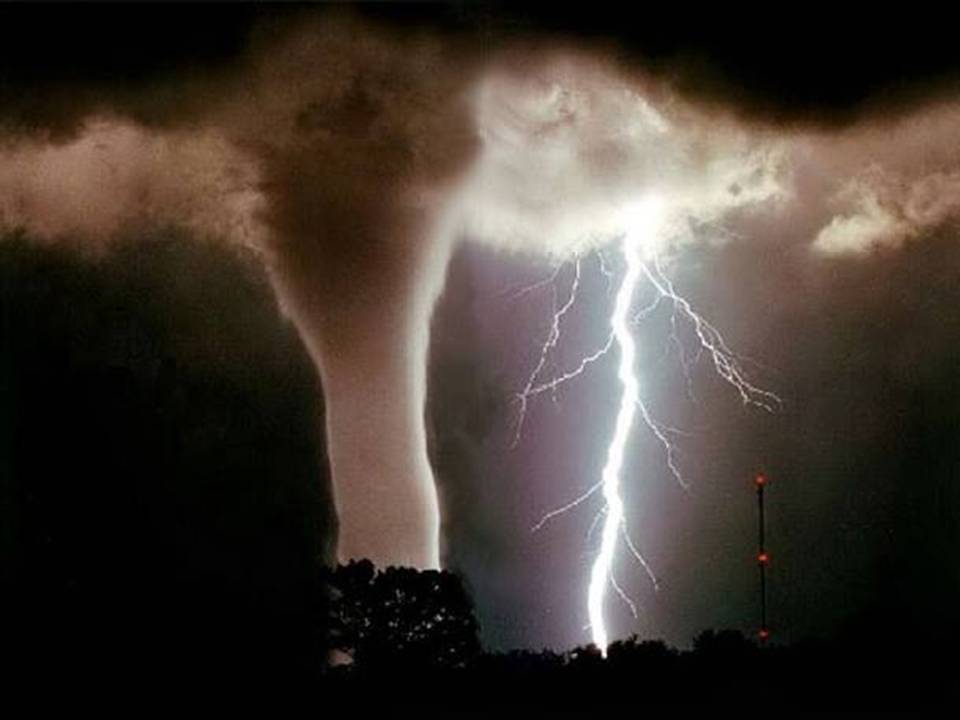
Just recently we had the largest, most massive tornado ever recorded—a monstrous behemoth of destructive chaos. One of the weathermen told everyone in the El Reno and Mustang area to head south, because the tornado was moving northeast. People got in their cars and headed south. To the shock of the meteorologists, so did the tornado! The thing stopped on a dime and headed south. Totally unpredicted, making the course of the tornado uncertain.  The meteorologists were astonished. (Above is a picture of that tornado).

As it is with nature, so it is with human life. Or is it the other way around, since Creation fell with us?—as it is with human life, so it is with nature? Life is full of uncertainty and unpredictability. At times life falls into chaos, and nothing fells worse than chaos.

Every Friday night I do a 12 hour shift at a large metropolitan hospital, usually in the state’s only level one trauma center. I see lives that have plunged into chaos, their world spinning uncontrollably, like being caught in a tornado. The parents who’s “high school star” son shot himself in the mouth. They told the doctor they had no warning signs whatsoever—this was totally unpredictable. The man fighting for his life from what turned out to be a fatal gunshot wound, all because he was standing in the wrong place at the wrong time between two rival gangs as he was going out to his car in the parking lot. The young teenage girl who was told that her teenage brother died in the accident—the accident in which she was the driver. Her scream still haunts me.

Chaos. Lives, solar systems, galaxies spinning out of control in a Universe that is falling apart. That’s how it seems. That’s how it feels when our world is out of control, falling apart.

A co-worker recently told me that her husband was called into the office, was thanked for 12 years of excellent work for the company, but that his position is being eliminated--immediately. As of that moment he had no job. There was no warning whatsoever. The room began to spin.

I have heard Christians in my tradition say that God is the God of order, and Satan is the author of chaos. Chaos needs to be simply rebuked in the name of Jesus. It needs to be rejected. Cast away. I told a family that the beloved member was not going to survive his fatal wound. For the daughter and parents, their worlds collapsed in on itself. The grandfather gathered the large family around for prayer and said, “Lord, we do NOT accept this. We rebuke the enemy!” The family member died.  

The God I read about in the Bible is the God who uses chaos at times, makes it His tool to bring about His purpose. He brought order from chaos in Genesis one. In the Old Testament He brought the armies of other nations to Israel to punish His people for their obstinate rebellion. He brought the Babylonians and allowed them to do the unthinkable—the very thing the Jews believed God would never, ever allow, no matter how rebellious they were: destroy the Temple in Jerusalem. But He did. Israel was in chaos, it’s brightest and best hauled away to Babylon for 70 years. And then God used another army, the Assyrian army, to deliver His people from Babylon, brought them home to rebuild the Temple. New order from chaos.

Jesus predicted chaos in Matthew 24: the fall of Jerusalem and the destruction of the Temple once again, in 70 A.D. And like a true prophet of God, Jesus predicts it in “End of the World” language, because it was the end of the world—their world. But from the chaos came a new order.

This is how God works in lives. From death comes resurrection. From chaos comes order. New order.
I don’t think God always brings the chaos upon us. I think more times than not the chaos hits us just from the fact that we live in a Fallen World. It comes from a driver that runs the red light, from the diagnosis of terminal cancer, from the tornado that stops on a dime and heads south, from the death of a spouse or child from something that is sheer accident—no one’s fault. But when the chaos hits, we panic. We freak out. We feel like just collapsing on the floor. At least, I do.

But then, if we cling to God, we watch Him bring order from the chaos. Sometimes quickly, sometimes its years later. But He does it.

Order from chaos is a powerful act of God’s grace in our lives. Life from death. New growth from beneath the ashes. Chaos sweeps away the old—and the familiar that we cherish so much and try so desperately to hold on to. The new is so scary—so unpredictable and uncertain.

We like “newness,” change, new order, in small doses. Like one minister in my tradition said at a youth council meeting, “We implement change in the church in small doses so we can control the outcome.”

Well, so much for faith. And so much for leaps of faith.

We like the familiar, and we like change in small doses, so we can have control—control is the opposite of chaos. Chaos is the loss of control. But chaos, uncertainty, unpredictability—those are parts of the mystery that is my life—they are things that help deepen the mystery.

Or, we believe that chaos violates the control of God. If things are in chaos, God is not in control. Remember the story in Mark 4:37-41—Jesus and His disciples are in the boat, and Jesus is down below, sound asleep. A sudden storm arises, and the disciples are scared to death that they are going to drown, and the go below to wake Jesus, crying, “Teacher, do You not care that we are perishing?!” And Jesus is not only perfectly calm, but basically asks why they aren’t calm as well. There was a belief in that day that God is SO in control that He can take a nap—He can go to sleep—and nothing will happen in the Universe that is contrary to His will. Not even during the deadly chaos of a storm at sea.

The existence of chaos in our lives does not mean that God is not in control. Quite the contrary. Genesis 1:1 tells me that God can and often does use anything in our lives, even chaos. Uncertainty and unpredictability.

In the Heisenberg Uncertainty Principle, those unpredictable and uncertain things that happen in the Universe do not deter the Universe from its predetermined path. In my life, because of God’s grace, chaos, unpredictability, and uncertainty do not deter the course of my life from its predetermined path, because of what God can do with them in my life. What a wonderful mystery!

For I am convinced that neither death nor life, neither angels nor demons, neither the present or the future, nor any powers, neither height nor depth, nor anything else in all creation, will be able to separate us from the love of God that is in Christ Jesus our Lord.
~Romans 8:38

Your Fellow Traveler Through the Storms,
~Steve

Friday, June 7, 2013

Laugh Hard

I had some eyeglasses. I was walking down the street when suddenly the prescription ran out.
I hate it when my foot falls asleep during the day because that means it's going to be up all night.

Sometimes when I’m in a crowded restaurant I get this overwhelming urge to stand up and yell, “I am not background for your life!”
~Comedian Steven Wright

Frankly, if someone does not have a good sense of humor, I really don’t care to be around them. I love humor, I love to laugh. I love watching comedies, both TV and movies. Having inherited my Dad’s love for the strange and unusual, I especially love off-the-wall, quirky humor—which does not thrill my wife at all. I watched the Ben Stiller movie, Dodge Ball, the other night for what?—the 1oth time?—and still laughed myself silly. “If you can dodge a wrench, you can dodge a ball.” How can that not be funny?  I can watch The Big Bang Theory over and over and over. And yes, I’m one of those who thinks that Napoleon Dynamite is sheer comedy genius.

During the growing up, formative years of my life, humor was one of the essential keys to my survival. I don’t mean physical survival, but emotional survival. The odd thing is that the man who made our lives a daily hell also had a great sense of humor, and even though I grew up hating his guts, I can also look back fondly at some uproarious times when we were laughing so hard we were both in tears.

It always made me wonder if Hitler had a sense of humor.

At times the humor was shared with Bud, my stepfather; other times it was at his expense, sort of a humorous revenge. My favorite was when I was 13 years of age. It was summer, and I’d been secretly angry at him for over a month, because on my birthday, he told me that we did not have enough money for a present for me—but we had the money that day to drive to Newport (over 30 miles away) for a case of beer and a bottle of whiskey. My “present” was all the Mountain Dews I could drink there and back. I was seething underneath over this. On the 4th of July I got my revenge. We were at the Heber Springs Lake, and the place was packed. Bud suggested we have a swimming contest, and he pointed off in the distance to our goal. But after a few strokes, I noticed that Bud had stopped swimming. I looked back and saw him parting the surface of the water with his hands, trying to peer down into the water. I went over to him and asked what he was doing. He made a “shushing” motion, finger to his mouth, and quietly said, “My uppers fell out. I want you to go down and see if you can find them. But be quiet about it.” I went down and immediately found his dentures lying on the bottom. But I thought to myself, This is too good to pass up. False teeth in my hand, I kicked out and swam under water as far as I could. Then I came up out of the water, holding his uppers high above my head and yelled as loudly as I could, “Found your teeth, Dad!” Like I said, the lake was crowded, and everyone around us cracked up laughing. My Mom and my sister were laughing so hard I thought they were going to fall off the picnic table. As for Bud, he was so embarrassed he almost turned purple. I knew I would pay for it. I was grounded for a week. It was worth it.

I could tell you story after story of hilarious times together, times when were egging each other on, and times when he was the butt of my practical jokes. I used to love to hide his pillow in the fridge. But he loved to laugh. Friday nights Mom would be working the 3 to 11 shift at Gray’s Hospital, my sister would be on a date, and Bud and I would sit in front of the TV watching Hogan’s Heroes and F Troop, eating potato chips and French Onion dip, drinking Pepsi’s and laughing. They were our best times together, and frankly, for me it made Bud someone that I could not totally hate, but could actually be fond of at times.

Humor became my shield. Not only was it one of my coping mechanisms, but unfortunately it also became something that I hid behind, well into my adult years. Showing honest emotions was too dangerous in our house, so I hid behind humor. As an adult, rather than saying what I really felt, I would make a joke. Making the other person laugh was my way of holding them off at arm’s length, especially if they were “invading my emotional space.” Needless to say, I had problems with my temper. I would “stuff” my emotions, hiding behind a smile and a witty remark, until the dam would burst, and it would not be pretty.

I’m still learning how to publicly express honest emotions, and it is still hard for me.

Well okay, like everything else, humor can be taken too far, can be used inappropriately. But still, for me, the journey would not be worth the trip if we couldn’t laugh so hard we almost wet ourselves at times. Studies are showing that there is true, healing power in laughter. One time I attended a laughter group. They started the meeting by standing around in a circle and laughing. Yes, it was faked, but they knew that there is healing power in even faked laughter—that’s how powerful it is.

Just recently I “worked a death” (as we call it in the chaplain profession) at a hospital.  The patient was medi-flighted in, rushed to emergency surgery, and died on the table. I was with his shocked, grieving widow and her sisters. Other family began to arrive. Lots of tears, lots of hugging, lots of “I can’t believe it,” and expressions of grief. At one point I was standing outside the consultation room, giving the family some private time, and heard uproarious laughter. I don’t know what it was about, but I knew it was appropriate. Sometimes something is so shocking, so rocks your world, that some humor is absolutely necessary, or you would lose your mind.

Laughter reminds us that not only will life go on, but that it is going on even at that moment.

My favorite times in life are laughing with my wife and daughter. My wife doesn’t laugh easily. I can be cracking up during The Big Bang Theory and she is sitting there with a perfectly straight face, and I wonder what on earth is wrong with her. But when she does laugh, it’s beautiful. It’s musical, and I love it. My daughter laughs as easily as I do, and it’s a wonderful laugh. Her eyes light up.

Personally, I think God has a fantastic since of humor. I mean, have you ever seen an Emu? God must have been cracking up laughing while He was creating that creature. I’ve always pictured Jesus sitting around the campfire with His disciples, all of them laughing so hard they were bent over, holding their stomachs. Honestly, I think at times Jesus was a real hoot to be around.

Okay, let me end this with one of my favorite humorous moments. My mother-in-law was as conservative and straight-laced as they come, and I loved to make her laugh. It gave me such delight. One Thanksgiving, she asked me to lift a completely thawed turkey out of the sink and set in on the kitchen counter. She was standing next to me as I did this, and she asked, “You don’t mind the feel of a thawed turkey, do you?” I smiled and said, “Naw! I used to date a girl that felt like this.” Suddenly, I heard this snorting. I turned, and there was my mother-in-law, on her knees in front of the sink, laughing so hard she was snorting and tears were coming out of her eyes. In all the years I knew Betty, I’d never witnessed her laughing so hard. She could hardly catch her breath. It was so unexpected and so endearing that it had me cracking up with her. It is one of my most cherished moments with my mother-in-law.

The journey of life must be filled with laughter along the way, or it isn’t worth the trip.  

Your Fellow Traveler,
~Steve

Friday, May 31, 2013

An Epiphany Along the Way

Life is a not a problem to be solved, but a mystery to be lived.
~Charlotte Joko Beck

There are a few sayings that I live by. One of them you see at the beginning of every post. Another one is also from Charlotte Joko Beck that I will share in this post.

The saying really made a huge impact on me during one cold morning 19 years ago. I was standing in the parking lot of a large insurance office building in Overland Park, Ks., a wealthy community in the Kansas City area. I had left a happy pastorate to be part of a church plant. Professionally speaking, it was my shot at the “the big time.” Being a minister is in many ways like other professional careers. We plan to “move up the ladder,” from larger church to larger church—well, at least, that was the plan. Except that for me, it wasn’t working out. Being a un-Orthodox, “quirky,” just-left-of-center minister in a very conservative denomination, I was almost forty years old and still in small churches. This church plant was my chance to be part of what was supposed to quickly grow into a contemporary, wealthy, mega-church. The only hitch was that I had to find a “secular” job to support myself until the church became large enough to start paying us salaries.

Pastoring skills mean squat in “the real world.” With over a double-major in Religion & Philosophy from college, a Master of Divinity Degree, and Doctor of Ministry work, plus over a decade of pastoring experience under my belt,  I found myself as a security guard at a nine-story office building, making minimum wage. “It’s simply a means to an end,” I kept telling myself. The church plant imploded, fell apart, and I was left in charge of helping it come to an end gracefully after a terrible conflict that took a very high toll on me. Now, being a rent-a-cop was no longer a means to an end, it was my job. At the age of 4o, when I should have been at the height of my “professional career,” I was making minimum wage, and my wife and I were going deeper in debt every year. And for what?

For some reason, the CEO of that office building decided that I needed to stand out in the freezing cold in the parking lot every morning, watching the cars come in, people arriving for work. I couldn’t understand it. Everyone I talked to at the company thought it was just as stupid as I thought it was, but there I was that cold winter morning, freezing my butt off, watching people with real jobs coming in to work.

I hit a new low in my spiritual depression, and I had been depressed for over a year. I was angry with God, and at the same time afraid that my worst insecurity fears about myself had finally come true—that I really was a failure. I had spent two years begging—I mean, begging and pleading—with God for a good job. And He wasn’t listening. So that morning, at the age of 40, and at the lowest point of my life, I seriously wondered if being a Christian was worth it.

I mean, we had given up a pastorate in Oklahoma, moved to Kansas City following God’s direction, swallowed the humiliation of not being able to get anything other than a minimum wage job—but I was doing it for the church plant—and I was each year going in debt. And the church plant collapsed. I had no ministry. WHY was I there? And was this what I got for following God’s leading—freezing my backside off in a parking lot for people who didn’t care? Is THIS what you get for faithfully following God?

I had never in my life been angrier at God, and that morning, I was seriously considering abandoning Him, abandoning Christianity, abandoning my faith, completely. Frankly, it wasn’t worth it. I’d had it.

Authors have always been my advisors, teachers, counselors and mentors, and they kicked in that morning. First, it occurred to me that I tried life without God before, and I was miserable then, too. So life without God was not a key to happiness. I remembered that from experience. For better or for worse, God was all I had. As one author, the psalmist Asaph wrote, “Who have I in heaven but You?” (Psalm 73:25). Second, I remembered Bernhard Anderson’s classic book, Understanding the Old Testament, and his treatment on the book of Job. He asks “the Job question”: Why are the pious faithful?  Was it for the reward, the payoff? Anderson asserts that the pious are faithful because it is who they are. I had to ask myself, Why was I a Christian? Was it for the payoff? For the Christian version of the American good life—the big church, big salary, new home and new car? Or was I faithful because as a Christian, that’s who I was? It really made me re-examine my motif for being a Christian. Had I been in it for the wrong reason? Should I not be faithful because being a disciple of Jesus Christ is who I am?

And then there was a quote from the Buddhist author, Charlotte Joko Beck. She was talking in one of her books about the Bible passage, Galatians 2:20, I have been crucified with Christ and I no longer live, but Christ lives in me.  Beck interprets that passage as meaning that since we have been crucified with Christ—the self is dead—I no longer live, but Christ now lives in me. Our lives, then, are not ours, they are His. And 1 Corinthians 6:19b-20, Do you not know that your bodies are temples of the Holy Spirit, who is in you, whom you received from God? You are not your own; you were bought with a price. We are not our own. We no longer live. Christ lives in us. Therefore, Beck concludes that since my life is not my own, then…

My life is none of my business.

It hit me like a ton of bricks. I belong to Christ. My life is none of my business. It was literally like a shaft of light broke through the heavy winter clouds. So what if I’m 40 years old and I’m a lowly, minimum-wage rent-a-cop freezing in the parking lot? It’s not my life. My life belongs to Christ, and if this is what He wants me to do, then who am I to complain? As Beck said, who am I to tell God that my life should be different than it is? That my life is not satisfactory, not what I want? It’s not my life anyway.

It all added up for me that morning when I was seriously considering walking away from The Faith.
                --I had lived without Christ in my life before, and I was miserable. Walking away from Christ wasn’t going to fix anything. For better or for worse, God was all I had.
                --Why had I been faithful? For the reward, or because being Jesus’ disciple who I am?    
                --And it’s not my life anyway. My life is none of my business.

I told Christ that morning that if this was what He wanted for the rest of my life, for me to be a minimum-wage security guard, then that truly was fine with me. My life was His, and He could do whatever He wanted with it. And a huge weight lifted off my shoulders, along with all the anger, disappointment, and a deep depression. At one point previously the depression had become so severe I literally thought I was cracking up. But from that morning on, not only did I have a peace I had never known before, I felt that my faith had reached a depth, a deeper level, than it ever had before.

I can’t tell you that the next day I got a great job offer. We stayed in Kansas City for another year, and I was happy to do so. The next winter we moved to Indiana, where I was on staff at a great church, and had 9 wonderful years there.

But I’ve never forgotten what I learned that day. That my life is none of my business. It makes the mystery that is my life an open frontier. The mystery is even more wonderful. It makes the journey lighter because it lessens the baggage. It means more contentment because if I am following Christ, I cannot look at my life and say, “This is wrong. This isn’t what my life is supposed to be like.” Who am I to say?

I have been crucified with Christ. My life is not my own. It is Christ living in me. My life is none of my business.

How liberating!

Your Fellow Traveler,
~Steve

Monday, May 27, 2013

Moore, OK Chapel Message

Below is a message I gave at the Oklahoma Heart Hospital Chapel Service.

OHH Chapel
May 25, 2013
Chaplain Steve Gillihan

We know that the whole of creation has been groaning as in the pains of childbirth right up to the present time. ~Romans 8:22

My grace is sufficient for you, for my power is made perfect in weakness. ~2 Corinthians 12:9

For the past week I have been struggling with what to say this Sunday.

We have seen the pictures of the monstrous, powerful, awesome tornado that went through Moore, ripping a path of terrifying destruction two miles wide and seventeen miles long, with a wind force of such magnitude that possessions have been found as far away as Arkansas.

All I know is that when Humanity fell in the Garden of Eden, Creation fell with us. Rather than there just being life in this world, from then on life and death has existed side by side. And not just for humans, but for nature as well. Beauty and ugliness. Good and evil.

Friday at Mercy’s Medical Tent, I spoke with a volunteer who has been working in the heart of the devastation. He was suffering from shellshock. Eventually the magnitude of the destruction had taken a toll on him emotionally. That night as I was working my shift at OU Med, I was listening to the chaplains there tell the horrific stories of working in the ER and Trauma units that night.

But on the other hand, back at Mercy’s Medical tent on 4th street, I was also overwhelmed by the magnitude of love and compassion that I was seeing all around me. At the church grounds we were stationed at, I saw mountains of clothes that were being brought in for the victims. I smelled the grilled chicken sandwiches that were being cooked and handed out non-stop. Every church seemed had been turned into a relief center. I saw tent after tent lining SW 4th street with mountains of bottled water, clothing, even places where families could recharge their cell phones. I spoke to one woman who had significant damage to her home. She was pushing a shopping cart full of clothing. I asked her if she had enough food and she laughed and said, “Oh, chaplain, we have more food than we can eat!” I met and talked with volunteers from Utah, Arkansas, and Wisconsin who came not with church or relief groups, but just on their own, because they wanted to help.

Standing at the back parking lot of the church property, I looked across the field at the devastation of the tornado. Homes ripped apart. The land marred with debris. Then I turned around and saw I don’t know how many people, donating clothing, passing out hot meals, free medical attention being provided, volunteers walking past me to head across the field to help with the clean up. I was standing between such ugly destruction on the one side, and the beauty of loving compassion on the other.

This is the world we live in. Human beings are capable of such ugliness and cruelty, yet also of such compassion and beauty. Nature is the same way. It’s like this created world reflects its inhabitants.

I moved here from Denver. I clearly remember the awesome beauty of the snowcapped Rocky Mountains, and how they filled me with awe. I also remember seeing rescue helicopters flying over my head, on the way to Long’s Peak, to rescue hikers who have been injured by the treacherous nature of such beauty. I remember sitting in a lawn chair at sunrise, surrounded by a small herd of elk—such majestic creatures—grazing all around me. And incredible experience.  I also remember seeing a bull elk chasing tourists, those huge, dangerous antlers pointed right at them, ready to wreck havoc because they dared to get too close during mating season when these majestic animals can be particularly dangerous.

Nature is filled with such awesome beauty, and such awesome danger. Just like we can be.

As a trauma chaplain, I’ve seen patients brought in with ugly wounds inflicted upon them by another human being. Stabbings. Gun shot wounds. Beatings with a baseball bat. And then this week I’ve seen so many people rushing to Moore, Oklahoma with overwhelming love and compassion that is just awe-inspiring and deeply moving.

Not just as people, but also with nature, we live with the duality of the fall from Eden, where life is filled with love and hate, beauty and ugliness, compassion and violence, awesome beauty and awesome destruction, good and evil, life and death. As it is the way of Humanity, so it is the way of Nature that fell with us.

And in this, God promises us that His grace is sufficient. And His grace more often than not comes to us through others, the ones He sends to us to give us a bottle of water, a hot meal, clothing, medical treatment, shelter, even a shoulder to cry on, a person who will pray with and for us. This is when we, the Created, best reflect our Creator. It is when we best reflect the love of God.

People experience the love of God
by being loved
by people who love God.


I don’t know how this week has been for you, how this devastating tornado effected you or yours. I just want to remind you that God’s grace is sufficient in this world of beauty and danger.

Saturday, May 25, 2013

Traveling With What You Inherited

Life is not a problem to be solved, but a mystery to be lived.
~Charlotte Joko Beck

In my last post I said that my daughter, Meghan, inherited my Mom's personality. Mom was not exactly "church material," however. She liked to smoke, drink, cuss, watch raunchy movies, and didn't like anyone telling her what to do. Mom's hero was Cher, because Cher did what she wanted, said what she wanted, and didn't care what anyone thought about it. My step-father, Bud, finally got my Mom to go to church, and when I found out that it was a Southern Baptist Church, I knew it wouldn't last. One Sunday the minister preached against women laying out to get tans. That was it for Mom. She loved laying out in the sun. I remember growing up Mom taking me and my best friend, Ricky, down to "the sandbar," the shore of the White River, so we could swim while Mom laid in the sun, tanning with her favorite, homemade, tanning oil: half baby lotion, half Iodine, in one of my step-father's empty whiskey bottles. Mom was always extremely tanned in the summers, very dark. She decided that this minister "does not like women," and she never went to church again. My daughter inherited my Mom's independent spirit and problem with authority. I inherited Mom's problem with authority as well.

This is why my heroes have always been the somewhat rebellious, smarmy, wise-cracking characters: James Garner's Brett Maverick character, Bruce Willis' John McClain of the Die Hard movies, M*A*S*H's Hawkeye Pierce, and my favorite of all, Dr. Johnny Fever of WKRP in Cincinnati. Being a minister and a "responsible, dependable" worker, I can follow the rules, but I do so with a cavalier, smarmy attitude. But hit me over the head with the rules, and I'll show you how many of them I can break. And as for telling me what to think--excuse me, I have a functional IQ. I don't need anyone telling me what to think. Needless to say, I have a love/hate relationship with the religiously Conservative circle that I am a part of.

From my Dad I got my physical build (big gut and no butt), his love for futuristic inventions, and off-the-wall sense of humor. My wife, Teresa, said that she never understood me until she met my Dad. I'm a sci-fi lover (HUGE Star Trek freak) and a fan of Will Farrel, Steve Martin, and Mel Brooks comedy. Whenever I'm sick, Talladega Nights, Dodge Ball, The Jerk, Young Frankenstein, or Blazing Saddles can always make me feel better.

Now, for me, this is all the fun stuff I inherited, and as you can probably tell, it is the stuff that I really enjoy. But we also inherit stuff from The Dark Side of our parents.

I inherited my Dad's cranky-ness,. Actually, all the men in my family turned out to be cranky old men. Negativity and judgementalism is something that I fight against. It is easy for me to go to the "worst possible outcome" scenario when something happens. If I don't watch myself, I can go around thinking cranky, negative thoughts which puts me in a crabby mood that comes out suddenly when my wife says something, I snap at her, and she responds with, "Where did that come from? Why are you in such a bad mood?" Even though I may respond with, "Well, it's your fault because you said (or did) such-and-such," the truth is, I had myself in a bad mood because of my negative thoughts. I can go around griping and grumbling with really no one to blame but my own mind. Age is not helping!

I also inherited my Mom's proneness to chemicals. Mom was a chain smoker, alcoholic, and heavy-duty prescription drug addict. Actually, all of this ran in her family. We called her sister, Virginia, the Tranquilizer Queen. Her speech was always slow and slurred. Chemical abuse flows through my Mom's side of the family like a river. When I was in my early 30's, I had to have oral surgery, and that's when I found out that I inherited from my Mother a proneness for narcotics. The surgeon said that the mild dose of Valium had me too relaxed, and the numbing shots took effect in half the time they should have. Even though that evening I was in terrible pain, the doctor told my wife, "There's no way I'm giving him a narcotic pain reliever. He's too prone to narcotics. I don't want him getting addicted."

But early in life I began to wonder: are we predestined by what we have inherited from our parent's Dark Side? Are our lives programmed by it? Was I "destined" to repeat the sins of my parents and grandparents, aunts and uncles?

Anyone who lives with me can tell you that I still battle crabbyness and negativity. "Shit" is one of my favorite words, and as far as I'm concerned, there's a lot of it in life that I have to put up with. When it comes to negative thoughts, I can go to the Dark Side easily and quickly. But I remember my Mom referring to her Dad as, "that mean old man." I made the decision that I am not going to be another, typical Crabby Old Man in my family. It's up to me. I can take on the family baggage and wear it like a mantle, or I can decide to dump it in the desert where it belongs, and travel light. I am what I think, and I don't want to think negative and crabby. Years ago I determined to think more positively and live with less fear. And I can be a bit self-involved and distant. My wife is good at bringing me out of that.

As for chemical addiction, I made that decision when I was very young. I have only taken vitamins and health supplements during my adulthood. I have never been on any prescribed medication. I drink very moderately and enjoy a good cigar only once a year. As a result, I am the healthiest person I know of in my family.

I have also stopped the family cycle of racial prejudice. However, I have my own brand of prejudices, it turns out.

When it comes to what we inherit, cycles can be broken. We can choose to have something stop with our generation. "It stops here! With me!" And in doing so, I think we honor our parents and grandparents by emulating what we enjoy and admire about them, not what we feel doomed to repeat.

Who are parents and grandparents are, or were, always goes with us during our travel through life. It is a blessing, and can be a curse. It's up to us. As for me, I want to be the smarmy, easy-going, laid-back guy.

It's a matter of what we decide to do with what we've been given.

Your Fellow Traveler,
~Steve

Friday, May 17, 2013

The Journey is a Generational Thing

Life is not a problem to be solved, but a mystery to be lived.
~Charlotte Joko Beck

For when David had served God's purpose in his own generation, he fell asleep; he was buried with his father and his body decayed.
~Acts 13:36

Lord, You have been our dwelling place from generation to generation...
~Ps. 90:1

I'm the kind of person that likes to hang out in cemeteries. I walk around reading the headstones. Rarely do I find one with the name Gillihan on it. The ones that make me stop are the ones that have a date related to May 13, 1954. My birthday. If the headstone shows that the person was born or died on May 13, 1854 or died on May 13, 1954, I stop and ponder about the life of that person. Who was that person? What was their life like, especially if it was 1854? What did they struggle with? What was the world like then? What was a spiritual life like for them, if they had one? Sometimes I also wonder if a person born on May 13, 2054 would be standing before my headstone, pondering the same questions about me. "Huh. This guy was born 100 years to the day before I was. Wonder who he was and what life was like back in his day?"

I have often wondered about the daily life and struggle of my ancestors as they carved out a life in Arkansas. Is there anything of any one of them in me?  I look up at the night sky and wonder if any of my ancestors had the same questions about life as I do, as they looked up at the same sky.

I once read that part of spiritual growth is finding our place in the flow of the generations. Our place in history. Of course, as you think backward to those who came before you, you also naturally think forward about those who will come after you. This is especially the case now that I am going to be a grandfather for the first time. I see a lot of my Mom's personality in my daughter, like it jumped a generation. Will my daughter say of my grandchild, "Good, Lord! He's/she's just like my Dad!" How much of me will be in that child? And what change will that make now in my place in the flow of history, the flow of the generations, now that a new generation is coming from my child?

I tease my son-in-law that since he will teach this child about Star Wars and Marvel comics superheroes, I will counter this by teaching my grandchild about Star TREK and DC comics superheroes, so the the child will "be balanced." Fun stuff, but superficial. I have have also told my daughter that since she would not let me teach her Martial Arts, I will teach it to this new one.

But what will I be able to pass on that really matters? How much will I be able to be a positive influence on this new generation that has flowed from me? What can I contribute that will be of any lasting depth?  I know that my wife will be nothing short of a remarkable grandmother, but what will I contribute? 

I know that I want to pass on the stories. Pass on 6 generations of family stories to the newest generation. Pass on my stories. Afterall, my wife and daughter claim that there's nothing I like better than a new audience for my stories. Grin. A sign of my approaching 60? And I want to take joy in hearing my daughter pass on her stories. I think it is important to make the stories of our ancestors, grandparents, parents, and our own stories a part of their story. It gives continuity. Too often young people today want to act as though they were born in a vacuum, as if nothing much of any importance happened until they came along. They don't care because it didn't involve them. We are not born into "the vacuum," we are born into the flow.

And there is The Faith.
I will not be this child's parent. I will have limited say about his/her spiritual life. And that is as it should be. I'm not going to be the parent. What I hope for is to be a grandparent that models a Christianity that is real, that is relevant, that is fun, and that has depth. My prayer for my daughter as she was growing up was that she would not find the Jesus of the church, but the Jesus of the Bible. That is my prayer for this grandchild that we are expecting. However, whether this prayer comes about or not, I will always love the stuffin's out of this kid.

I think that in some way we become concerned about our journey lasting longer than we do. That's why it's important to be able to pass on things to the next generations. Invest a part of ourselves in them, just as they invest part of themselves in us, contributing to our journey. My daughter has made my life richer just by being my daughter. She is a person of spirituality and depth. I'm looking forward to her child doing the same for me--child of my child. And there's my son-in-law's stories, and the stories of his parents and his grandparents and on back, that will add to the child's journey. He will be a great Dad. He's a man of quality, and he will bring a neat military background, a man serving his country. An honorable contribution to his child's journey. When it comes to parents, my grandchild will be blessed.

And there's the contribution of my son-in-laws' parents, their stories that they will pass on to a new generation. I just found out last Christmas my son-in-laws' Mom lived in my adopted hometown of Batesville, Ark. We had fun comparing stories and landmarks.

I really didn't know my paternal grandfather. He visited a few times when I was very young, but died in the 1960s. I did know my maternal grandfather. I really think the movie, Grumpy Old Men was partly based on his life, except he wasn't endearing like those two old coots. I remember my Mom referring to him as "that mean old man," and she was right. It was my father-in-law who really modeled for me what it means to be a Christian man, husband, and father, and a grandfather. He's the one I miss the most. I smile whenever I remember him. Now that I've just turned 59 and am looking forward to being a 1st time grandparent, I wonder how I will be rememberd? What will be my contribution to the flow of the generations?

I do know this. My contribution will not happen by accident. Nor do I want it to be a by-product as I pursue a self-centered, entertained and distracted life, replacing meaning with busy-ness like much of our society.

Maybe I should make a Bucket List of what I want to model and pass on to my grandchildren.

I wonder: someday, when my grandchild is a grandparent, he or she will stand at my headstone with his/her grandchildren and great-grandchildren, and tell them about me? What will be said?

And my journey will outlast me.